Make an appointment with your doctor to discuss the need for travel vaccinations.
Remember! You may need more than one dose, so plan ahead and make sure you see your doctor early to make sure you are fully vaccinated before you leave!


Make an appointment with your doctor to discuss the need for travel vaccinations.
Remember! You may need more than one dose, so plan ahead and make sure you see your doctor early to make sure you are fully vaccinated before you leave!
When you or someone you know is sick but you don’t know where you should get help from, consider these options before calling 000.
Make an appointment to see your GP, you can call reception on 8038 1070 or book online via health engine.
Call Health Direct Australia 1800 022 222
Healthdirect Australia is a 24-hour telephone health advice line staffed by registered nurses to provide fast and simple expert advice on any health issue and what to do next.
Sydney Medical Service (02) 8724 6300
Bulk billed home visits after hours, weekends and public holidays
Pharmacist
Visit your pharmacist for over the counter medications and medication advice.
Waitara Family Medical Practice is offering free shingles vaccine to people aged 70, with a catch up program available for people aged 71 – 79.
Herpes-zoster (Shingles) is a painful blistering rash caused by reactivation of the varicella zoster virus – the same virus that causes chickenpox. The shingles rash occurs when the dormant chickenpox virus is reactivated in the nerve tissue, causing inflammation of the nerves. Sometimes pain in the affected region can be severe and prolonged.
1 in 3 people will develop shingles in their lifetime. As a person gets older, the risk of getting shingles increases.
Routine vaccination of persons aged 70–79 years is expected to obtain the greatest benefits against shingles and its complications.
There is no cost for the vaccine if you are aged 70 – 79, and all visits are bulk billed. For more information and to make a booking, call (02) 8038 1070 or book online via our website.
We hope everyone has had a lovely festive season.
We are open today from 9am, to make a booking please call 8038 1070 or book online on our website.

Waitara Family Medical Practice wishes everyone a Happy New Year!

We will be closed on the 31st of December (New Years Eve) and re-open at 9am on Tuesday 3rd January.
For non-urgent medical assistance, please call Sydney Med – home GP service (02) 8724 6300. For medical emergencies, the closest Hospital is Hornsby Hospital on Palmerston Road, or call 000 for an ambulance.
We hope you had a wonderful Christmas break, celebrating with family, friends and loved ones.
We have shortened Christmas hours for the next 3 days, we will be open from 9am to 5pm Wednesday 28th, Thursday 29th, and Friday 30th. We will be closed over New Years from the 30th, re-opening January 3 at 9am.
To make an appointment call 8038 1070, or book online via our website.
Waitara Family Medical Practice wishes all patients, family and friends a very Merry Christmas and a happy and safe festive season.
We will be closed from 1pm today (24th December) and we will open again 9am Wednesday 28th December.

For non-urgent medical assistance, please call Sydney Med – home GP service (02) 8724 6300. For medical emergencies, the closest Hospital is Hornsby Hospital on Palmerston Road, or call 000 for an ambulance.
Being able to do CPR could save a life! Do you know how to perform CPR correctly? How to use a defibrillator? What to do in an emergency situation?
If no CPR is performed, it only takes three to four minutes for the person to become brain dead due to a lack of oxygen.
By performing CPR, you circulate the blood so it can provide oxygen to the body, and the brain and other organs stay alive while you wait for the ambulance. There is usually enough oxygen still in the blood to keep the brain and other organs alive for a number of minutes, but it is not circulating unless someone does CPR. CPR does not guarantee that the person will survive, but it does give that person a chance when otherwise there would have been none.
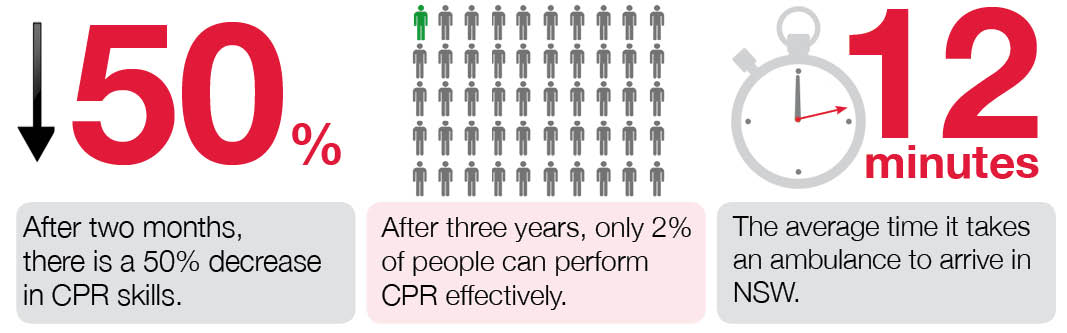
CPR is a life saving skill that everyone should learn. You should update your knowledge annually to make sure you’re confident at performing CPR, which in an emergency could save a life.
This information is not substitute for proper CPR training by an accredited organisation. Visit St John’s Ambulance website to find course locations.

Waitara Family Medical Practice will be closed over the Christmas and New Year period. Our opening hours are as follows:
Saturday 24th December 9am to 1pm
Sunday 25th December CLOSED
Monday 26th December CLOSED
Tuesday 27th December CLOSED
Wednesday 28th December 9am to 5pm
Thursday 29th December 9am to 5pm
Friday 30th December 9am to 5pm
Saturday 31st December CLOSED
Sunday 1st January CLOSED
Monday 2nd January CLOSED
Tuesday 3rd January 9am to 7pm
For medical emergencies call 000 or present to Hornsby Hospital Emergency Department. For non-urgent medical conditions on weekends and public holidays, please call the Sydney Med Home GP service for bulk billed home visits 8724 6300.
It is now summer and the warmer weather means we will be spending more time outdoors, it is important to be sun-safe!
Australia has one of the highest rates of skin cancer in the world. In 2013, more than 2,200 Australians died from this almost entirely preventable disease.
The main cause of skin cancer is overexposure to UV radiation. This is produced by the sun, but it can also come from other sources, such as solariums (sun beds). While these are now banned in Australia, people who used a solarium before age 35 have an almost 60% greater risk of melanoma.
Most parts of Australia have high levels of UV radiation all year round. UV radiation cannot be seen or felt and it is not related to temperature, but it can cause:
The best way to prevent skin cancer is by using sun protection measures. Slip, slop, slap, seek and slide to protect your skin from overexposure to the sun and sun damage.

Wear clothing that covers your neck, shoulders, arms, legs and torso. The best protection comes from closely woven fabrics. For clothes designed for sun protection, the higher the UPF (ultraviolet protection factor), the greater the protection.
Apply a water-resistant sunscreen with SPF 30+ or higher at least 20 minutes before going outside, as it takes this long to sink into the skin. Reapply every two hours, after swimming and after any activity that causes you to sweat or rub the sunscreen off.
Wear a broad-brimmed hat that protects your face, neck and ears.
Use shade from trees, umbrellas, buildings or any type of canopy. Be aware that UV radiation is reflective and bounces off surfaces such as concrete, snow, water and sand, causing sun damage even when you think you’re shaded.
Wear sunglasses that meet the Australian and New Zealand standard AS/NZS 1067:2003 and have an EPF (eye protection factor) of 10. Wraparound styles are best.
For more information visit the cancer council website.